

My most careful, accurate video got 761 views.
A video of me writing my own name in the traditional Mongolian script got more than 133,000 views, 1,744 saves, 806 shares and 718 new followers. It was the third post on a brand-new account.
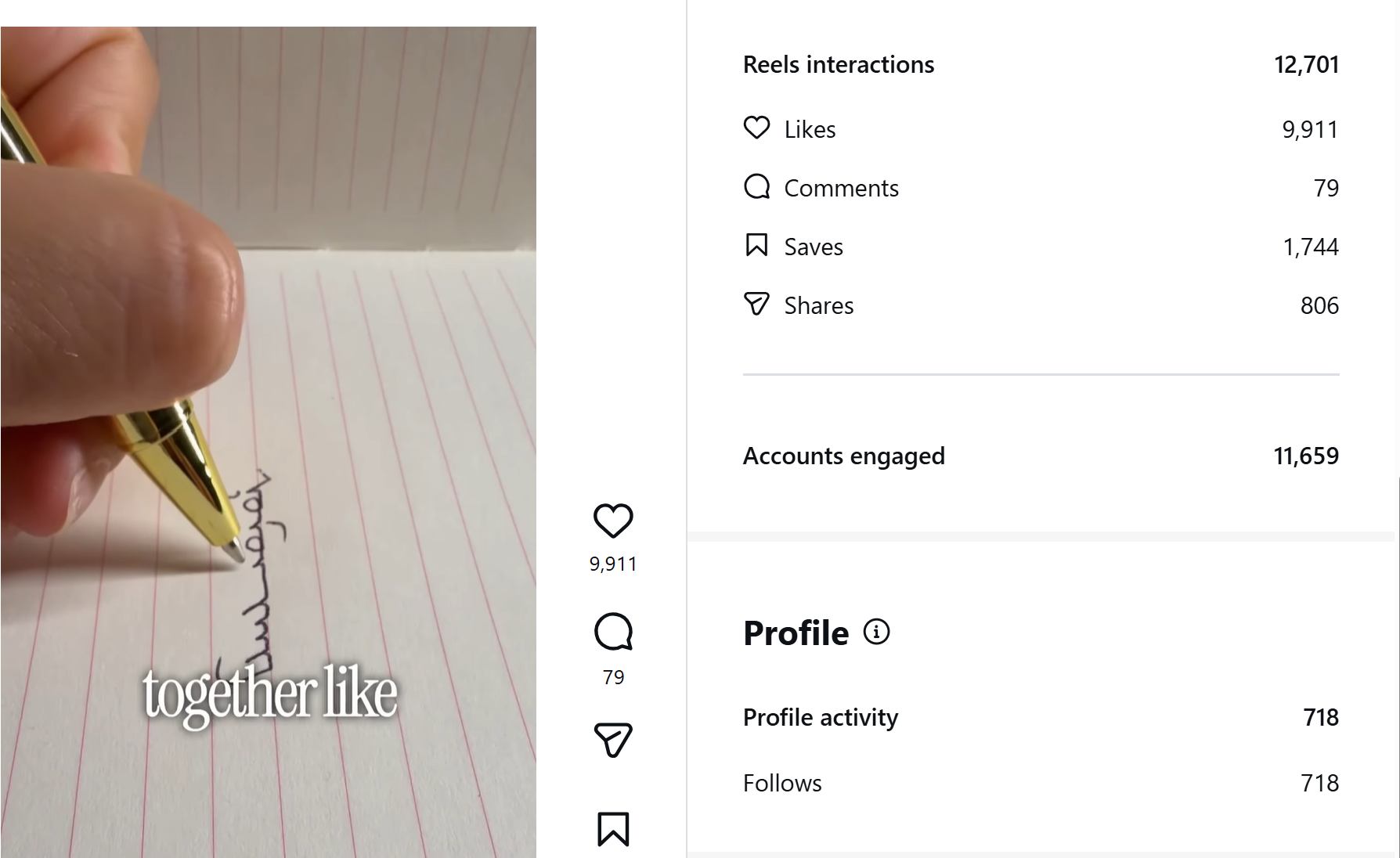
I've thought about that gap a lot. The first video taught people something. The second one made them feel something, then asked them to join in. That's a story problem, not a camera problem.
So this month I built a tool for the part of video I'm worst at: figuring out what the story is. This post covers why I didn't want another AI video generator, the exact prompt I used, what each step does, and where it still falls short.
The clip was never my bottleneck
Every week there's a new tool that promises a finished video from one sentence. I get the appeal. But when I looked at where my time actually went, the clip was never the problem. The blank page before it was.
I'd have a feeling about something, a sound from home or a word with no English translation, and no idea how to shape it into 45 seconds. My scripts ran long. My best line ended up somewhere in the middle. I used to spend days just thinking about an idea, and by the time I figured out what to say, some topics had already moved on and I couldn't catch up.
And honestly, I didn't want another monthly subscription for something I'd use once a week.
So I changed the question. Not "can AI make my video?" but "can AI help me think before I film, and then get out of the way?"
What I gave Claude matters more than the prompt
Before I asked for anything, I had a research doc on how storytelling creators grow: what their hooks do, how their series work, what their best videos have in common. Plus my own numbers, including that 761 vs. 133,000 gap.
That doc did most of the heavy lifting. Claude can build an app in minutes. It can't decide what a good video means to you. The research and the rules are the part only you can bring.
Then I wrote one paragraph. This is the actual prompt (I only fixed my typos):
Based on this research, can you help me create a little storytelling website that helps me brain dump my ideas, and from there create a storyboard, then the script, background music and voiceover? Add more things as needed. I want to grow my account with good quality content that can convert one reel into thousands of followers and engagement.
That's it. No code, no technical words. It took me about 10 minutes and only two rounds of changes to get the result I wanted.
"Add more things as needed" turned out to be the best line in it. I never asked for a fact check or a launch kit. Claude added both, and the fact check is now my favorite part.
Claude built it as an artifact, a small app it makes right inside the chat that I can open and use like any website.
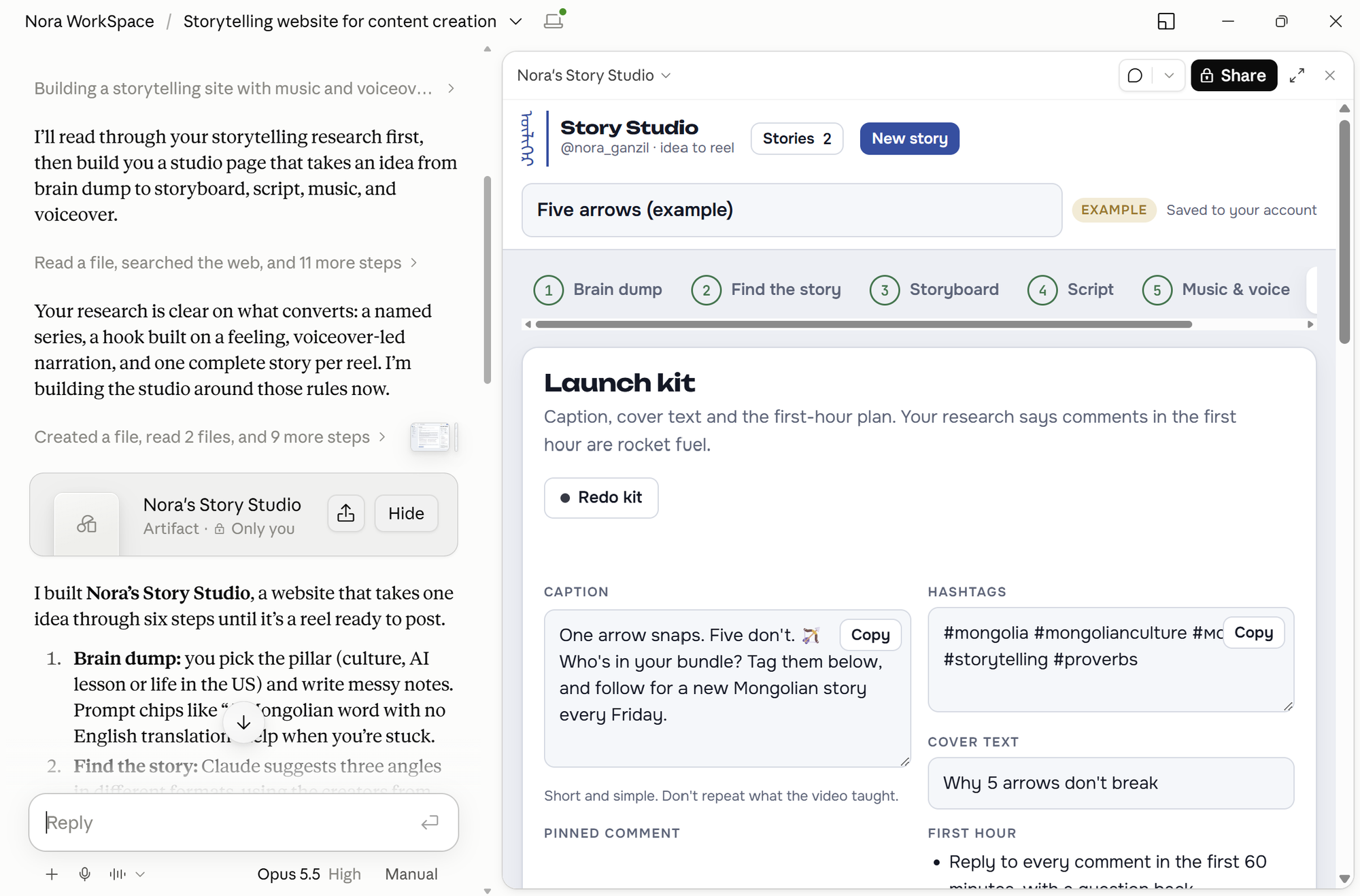
The part that surprised me: the app can call Claude by itself. Anthropic calls these AI-powered artifacts. Nobody manages API keys, and when someone uses a shared app, the usage counts against their own Claude plan, not the builder's.
Before marketing, I studied architecture, and nobody pours concrete from a napkin sketch. A reel works the same way. I just never had the drawings.
Six steps, using one real example
The studio comes with a worked example: a Friday culture video about a Mongolian proverb and five arrows. Here's what each step does with it.
1. Brain dump. I pick the pillar (Mongolian culture, an AI lesson or life in the US) and type everything in my head, in no order. If I'm stuck, small prompts help: "A Mongolian word with no English translation." "A moment I felt between two cultures this week." The five-arrows notes are messy on purpose: a proverb, a story from The Secret History of the Mongols, wooden skewers I could snap on camera, and who I want to feel it. No editing at this stage. The mess is the point.
2. Find the story. Claude gives me three angles, each in a different format. Every angle comes with a hook line, on-screen text, the feeling, the one fact a viewer would repeat at dinner, and when the payoff lands. I pick one. This is the step I used to skip, and I think most of us do. We fall in love with the first angle and start filming.
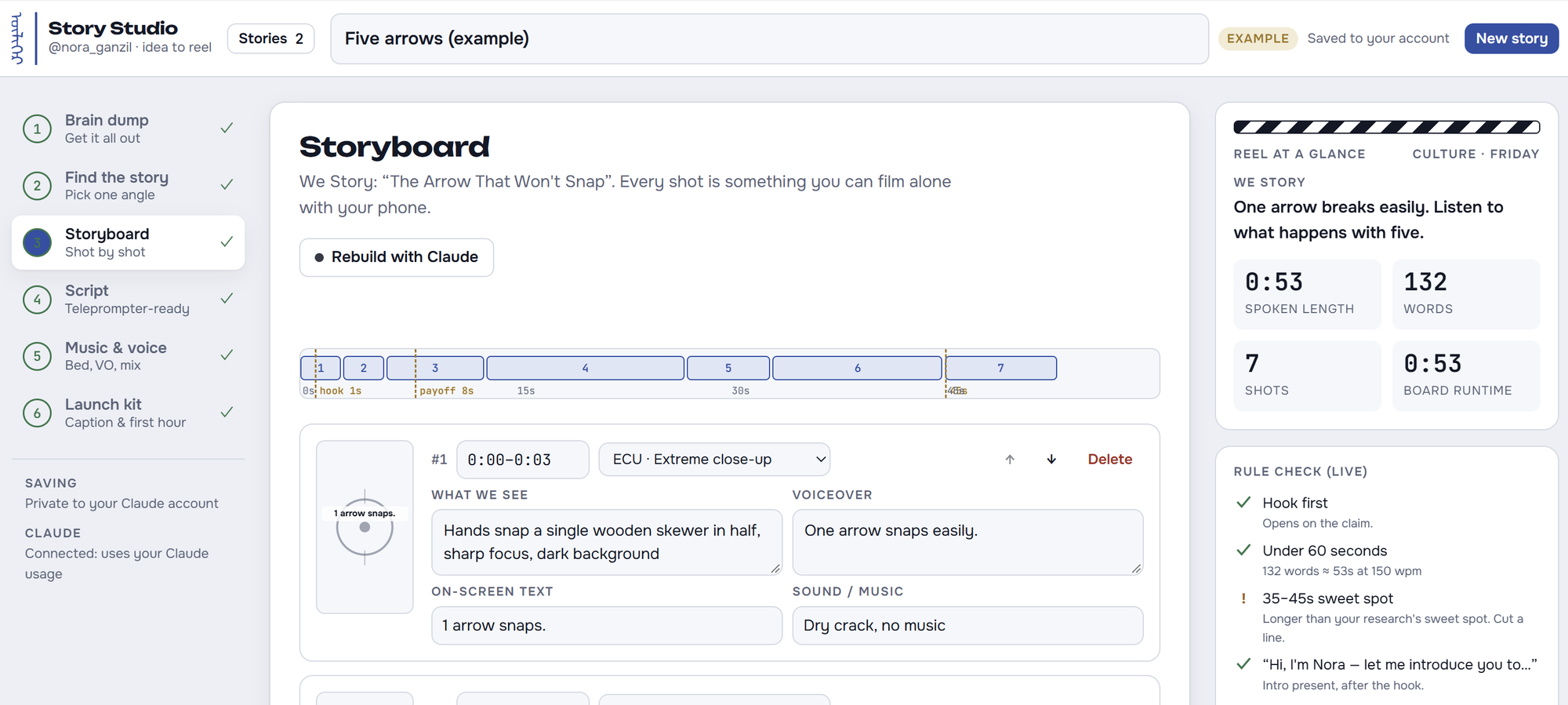
3. Storyboard. Shot by shot: timing, framing (close-up, overhead, B-roll), on-screen text, voiceover and sound. A timeline lays the shots against my targets: the hook in second one, the payoff by second eight. Every shot is something I can film alone with my phone. The first one is three seconds long: hands snapping one wooden skewer, no music, just the crack.
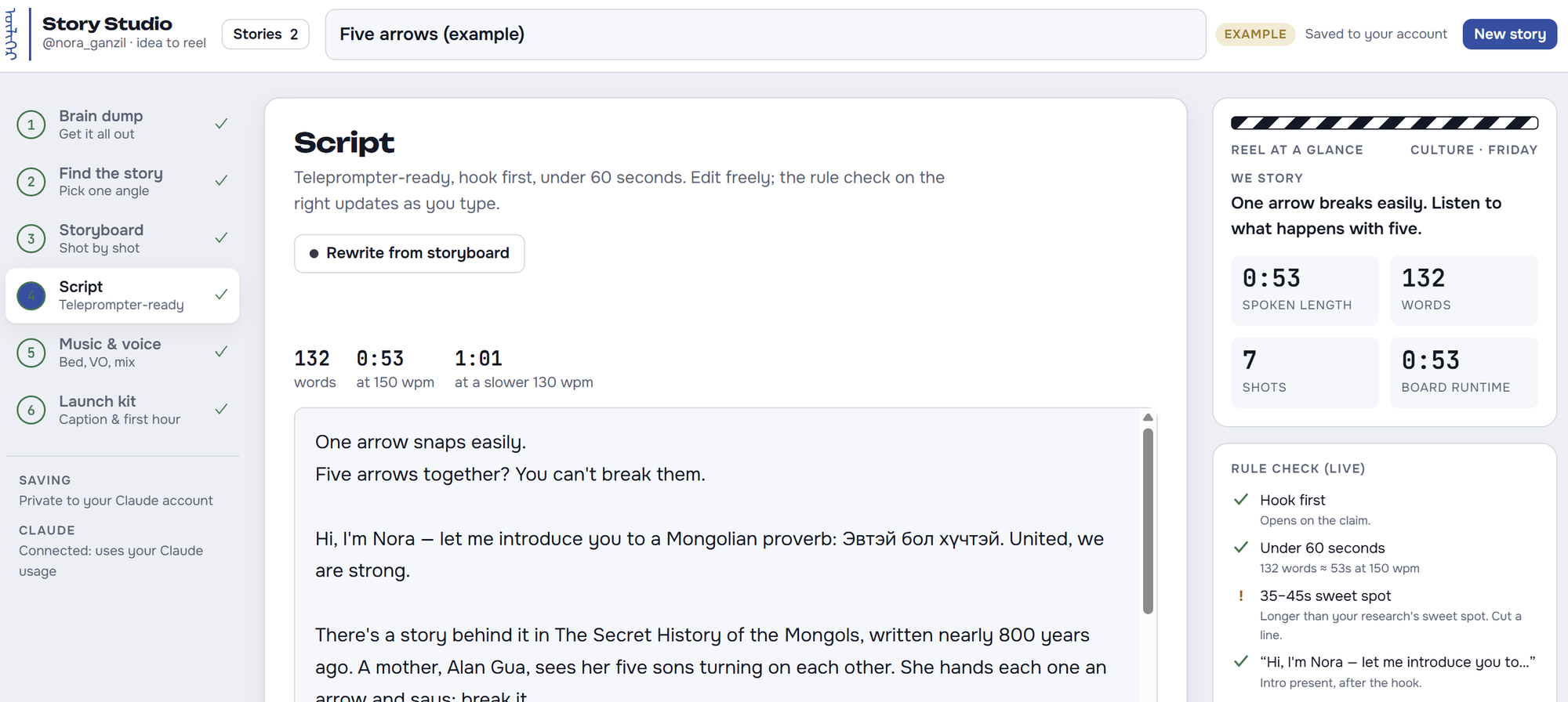
4. Script. A teleprompter-ready script built from the storyboard, with a checklist that updates as I type. Does it skip the intro and open on the claim? Is it under 60 seconds at about 150 words a minute? For culture videos, Claude also drafts Mongolian subtitles line by line and copies them in SRT format for my editing app. There's a built-in teleprompter, too.
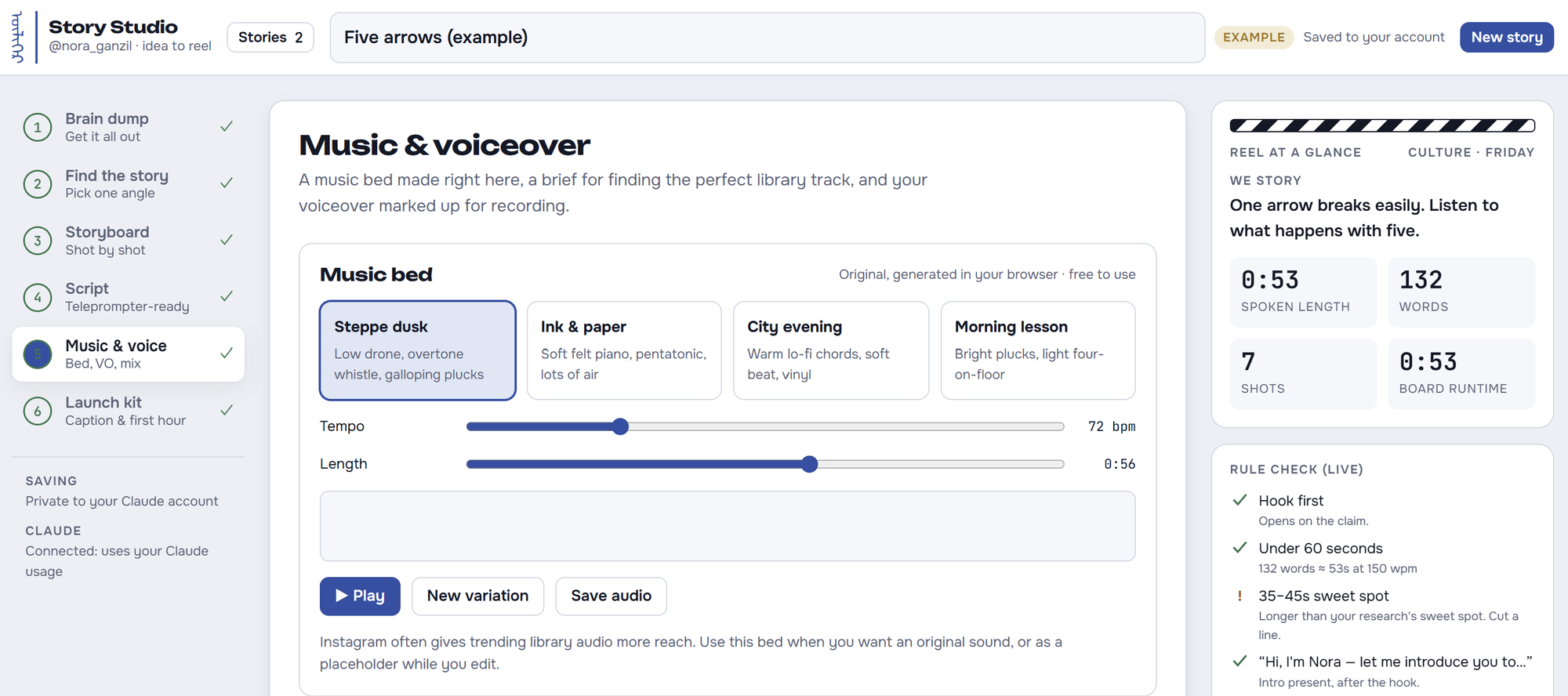
5. Music and voice. The studio makes a simple, original music bed right in the browser, using the Web Audio API that every modern browser has. I pick a mood, set the tempo and length, and press play. It marks up my script with pauses and the words to stress. Then I record the voiceover on my phone and upload it, and the studio mixes the two: the music plays full before I start talking, dips under my voice and comes back for the ending. I download one audio file (a .wav, zipped) for my editor.
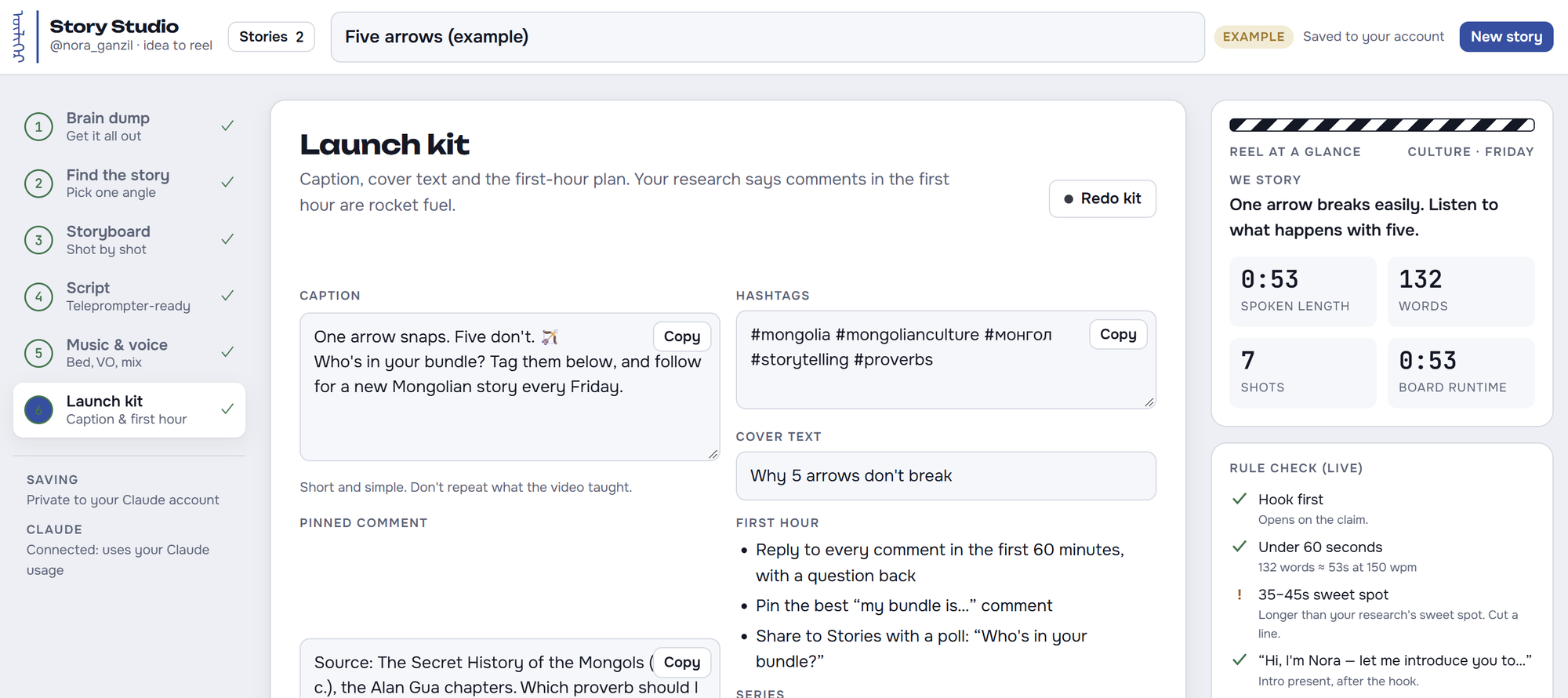
6. Launch kit. A short caption, a few hashtags, cover text, a pinned comment with the source, a plan for the first hour after posting, and an idea for the next episode. For the five arrows, the cover text was simply: "Why 5 arrows don't break."
The step that saved me from the comments
My favorite part isn't the creative one.
Before anything gets filmed, the studio reviews the script. On the five-arrows example, it flagged four things.
One of them: some popular retellings tell the five-arrows lesson with Genghis Khan, or with his mother Hoelun, instead of the person in the original text. In The Secret History of the Mongols, it's Alan Gua, a legendary mother whose five sons became the ancestors of Mongol clans. She hands each son one arrow shaft and says, "Break it." Then she ties five together, and none of them can. Film the popular version, and someone corrects you in the comments. And they'd be right.
Another: the date. Scholars still disagree on exactly when the book was written, with proposals ranging from 1228 to 1264. "Nearly 800 years ago" holds for most of them. "Exactly 798 years ago" wouldn't.
The studio doesn't decide any of this for me. It points, and the checking is still my job. For this one I didn't have to look far. I grew up in Mongolia, where this is a story every kid knows, because we all read The Secret History in school. (Igor de Rachewiltz's translation is free to read online if you're curious.)
What Claude does, and what stays mine
This matters to me, so I'll be direct.
Claude does the structure. It turns my mess into angles, a shot list and a checklist I'd otherwise keep in my head and forget.
Claude does the checking. Length, hook placement, facts that could be challenged, and whether I followed my own rules.
The story is mine. I choose the angle. I can combine two of them, or throw all three out and write my own.
The words are mine. The script stays a draft until I've said it out loud and rewritten it to sound like me. A script that sounds like a script is a script nobody finishes.
The voice and the face are mine. I record the voiceover and film every shot myself. My voice is the brand, and I'm not handing that to a generator.
Where it still falls short
I won't pretend this tool does everything.
I still edit every video myself. The studio stops at the plan and the audio, so cutting clips and placing subtitles happens in my editing app, and that part still takes time.
The music it makes is basic. I use it when I want an original sound, or just to have something playing while I edit. When a video needs more, the studio writes me a short brief for searching a music library instead.
It also only knows what I taught it. The rules came from studying a few storytelling creators I admire and from my own numbers, and they're built around my three content pillars. Your version should look different.
One practical note: the Claude steps count toward my Claude plan's usage, and saving stories to my account uses persistent storage, which is on paid plans as of October 2026. I didn't sign up for anything new.
Build your own version
You don't need my studio. You need your rules.
1. Write your rules first. Five things you already believe about a good video. Mine started like this:
- Open with the surprising part, never with "Hi, today I'll talk about…"
- Under 60 seconds spoken.
- One fact a viewer would repeat at dinner.
- The payoff on screen within the first few seconds.
- End with a question people can actually answer.
2. Gather what you know. Your best and worst videos and their numbers, plus a few creators whose work you'd love to learn from. Not to copy them. To see what they do on purpose.
3. Ask for your steps, not mine. Something like:
Here are my rules for a good short video, plus notes on what has worked for me. Build me a simple web app that walks me from a messy idea to a shot list and a script, and checks my script against these rules. Add more things as needed.
4. Test it on one real idea before you trust it. Then give it notes, the same way you'd give notes to a person.
Start small. One step that works beats six that don't.
Where I'm at right now
I'm not saying this is the right way to make videos. It's what's working for me right now, on an account with four posts. Ask me again at 10,000 followers. Take what's useful and make it yours.
Earlier this month, I wrote about competitive research with Claude in 15 minutes. Same lesson, different job: the tool does the reading and the checking. The thinking stays yours.
My 761-view video wasn't wrong. It just had no story.
What's the hardest part of making a video for you: the idea, the script or the filming?
Sources
- Claude Help Center: What are artifacts and how do I use them?
- Claude: Build and share AI-powered apps with Claude
- MDN Web Docs: Web Audio API
- Igor de Rachewiltz (trans.), John C. Street (ed.): The Secret History of the Mongols: A Mongolian Epic Chronicle of the Thirteenth Century (Western CEDAR, Western Washington University, 2015; open access PDF, via Fordham's Internet History Sourcebooks)
- Wikipedia: Secret History of the Mongols (dating debate)
If this was useful, next time I'll share how the five-arrows reel actually performed, and what I changed after. Subscribe so you don't miss it. And if you want to see the stories this studio helps me plan, I post a new one every Friday on Instagram.


Discussion