

When you build a marketing strategy, your success depends on how well you understand your customer. You cannot market effectively to a blank wall. To get a clear picture of who is buying from you, marketing professionals rely on two distinct types of data. These are quantitative data and qualitative data.
Knowing when to use each type of data is a core part of market research. One type gives you the scale and the numbers. The other type gives you the context and the human element. If you rely on only one, your strategy will have blind spots.
This guide breaks down how to apply both data types to define your buyers accurately. It provides a structured approach for your market research, ensuring your strategy is built on facts rather than assumptions.
Part 1: Gathering the Hard Numbers with Quantitative Data
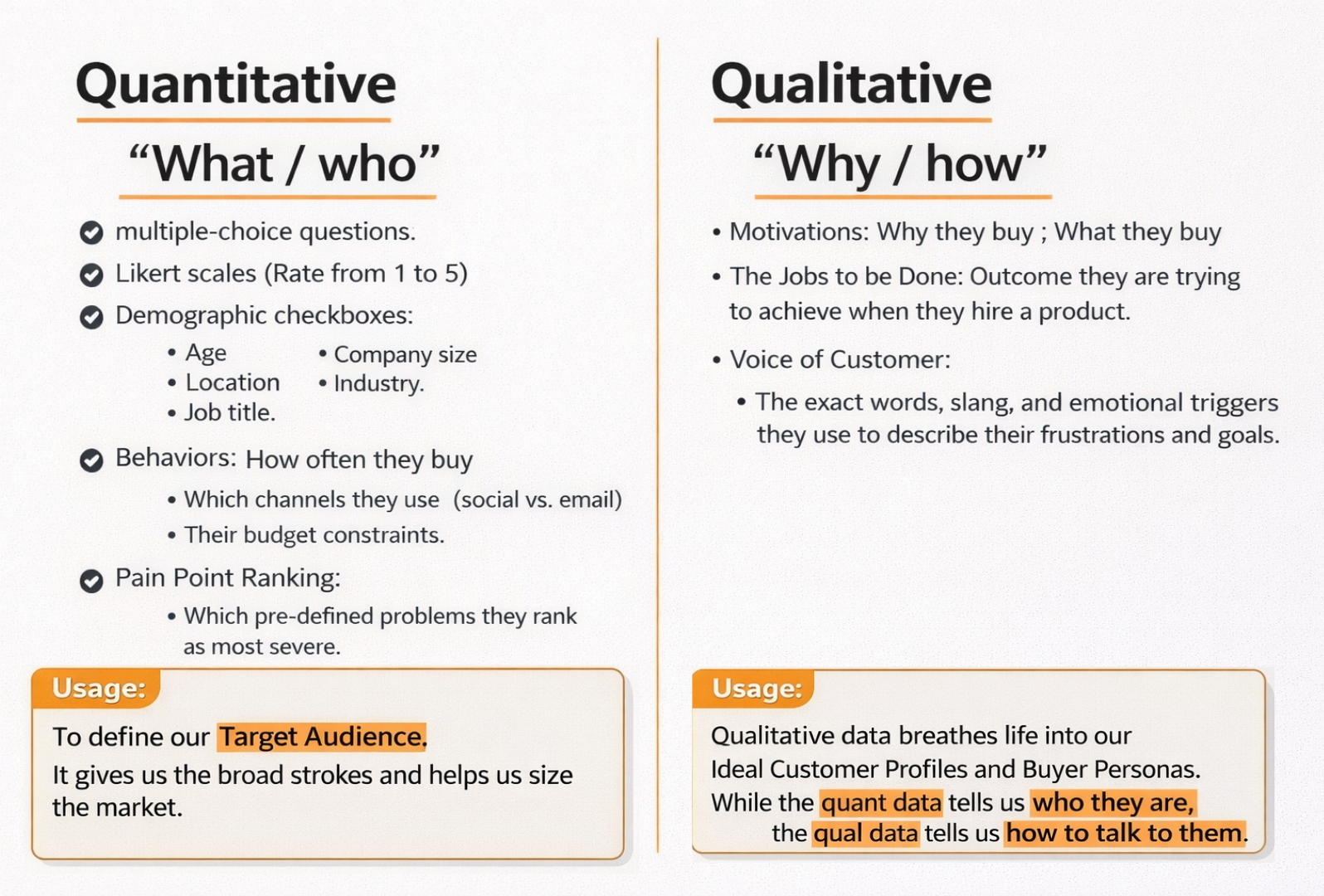
Quantitative data is the mathematical foundation of your market research. This data answers the "what / who" of your customer base. It relies on numbers, hard metrics, and structured formats that are easy to analyze across large groups of people.
When you look at this data, you are looking for patterns, averages, and statistical significance.
Standard Collection Methods
You gather this information through structured surveys that limit the user to specific answers. This prevents varied responses and keeps the data clean. Common formats include multiple-choice questions. These questions force the respondent to select from a predetermined list.
Another common format is Likert scales, where you ask respondents to rate from 1 to 5. For example, you might ask them to rate their satisfaction or agreement with a statement from 1 (strongly disagree) to 5 (strongly agree). This transforms subjective feelings into objective, trackable numbers.
Key Demographic Metrics
This data category is highly effective for capturing demographic information. You can use demographic checkboxes to build the basic outline of your customer. The core metrics include:
- Age: Collecting age data allows you to group your audience by generation. This helps you understand baseline media consumption habits.
- Location: Geographic data helps you understand where your demand is concentrated. This is necessary for regional ad targeting and localizing your message.
- Job title: In business-to-business marketing, the job title tells you the seniority and decision-making power of the person you are researching.
- Company size: This metric tells you if you are dealing with small businesses or large enterprises. Company size dictates budget capacity and the length of the sales cycle.
Tracking Customer Behaviors
Beyond static demographics, quantitative metrics track actions. You need to know how your audience behaves in the market. You can measure behaviors, such as how often they buy. Understanding purchase frequency helps you forecast revenue and plan retention campaigns.
You also need to track which channels they use, such as social versus email. If the numbers show your audience heavily prefers email, you know exactly where to allocate your marketing budget.
Establishing Pain Point Rankings
A crucial use of numerical data is pain point ranking. In your surveys, you provide a list of known issues and ask your market to rank them. This shows you which pre-defined problems they rank as most severe. By turning problems into a numbered list, you can prioritize your product messaging around the most urgent issues.
The Goal of the Numbers
Ultimately, we use this data to define our Target Audience. It gives us the broad strokes and helps us size the market. It tells you if there are enough people with a specific problem to build a profitable campaign.
Part 2: Finding the Context with Qualitative Data
Qualitative data provides the context behind the numbers. While your spreadsheets show you the scale of the market, this data answers the "why / how". It focuses on text, human experiences, and context rather than strict numerical values.
You gather this information through open-ended survey questions, customer interviews, and direct observation.
Understanding Customer Motivations
Numbers can tell you that a customer bought a product, but they cannot tell you the exact reason. Qualitative research uncovers core motivations, specifically why they buy and what they buy.
To understand this, marketers use the "Jobs to be Done" framework. This focuses on the outcome they are trying to achieve when they hire a product. Customers do not buy software simply to have software. They buy it to save time, reduce errors, or look good to their manager. Those underlying goals are the "jobs" they are hiring your product to do.
Capturing the Voice of the Customer
One of the most valuable assets you can generate in market research is the Voice of Customer. This involves actively listening to your market and documenting the exact words, slang, and emotional triggers they use to describe their frustrations and goals.
When you write copy for your website or advertisements, you should not guess what words will resonate. You should use the exact phrases your customers provided during qualitative interviews. If they call a problem a "nightmare," you use the word "nightmare" in your ad copy.
The Goal of the Context
This qualitative context is what makes your marketing feel personal and relevant. Qualitative data breathes life into our Ideal Customer Profiles and Buyer Personas.
To summarize the relationship between the two: while the quant data tells us who they are , the qual data tells us how to talk to them.
Part 3: Applying Data to Build Customer Profiles
When you reach the stage of identifying your buyers, you do not use all your data at once. You apply these data types differently across three main assets. Each asset serves a different purpose in your marketing strategy.
1. Defining Your Target Audience
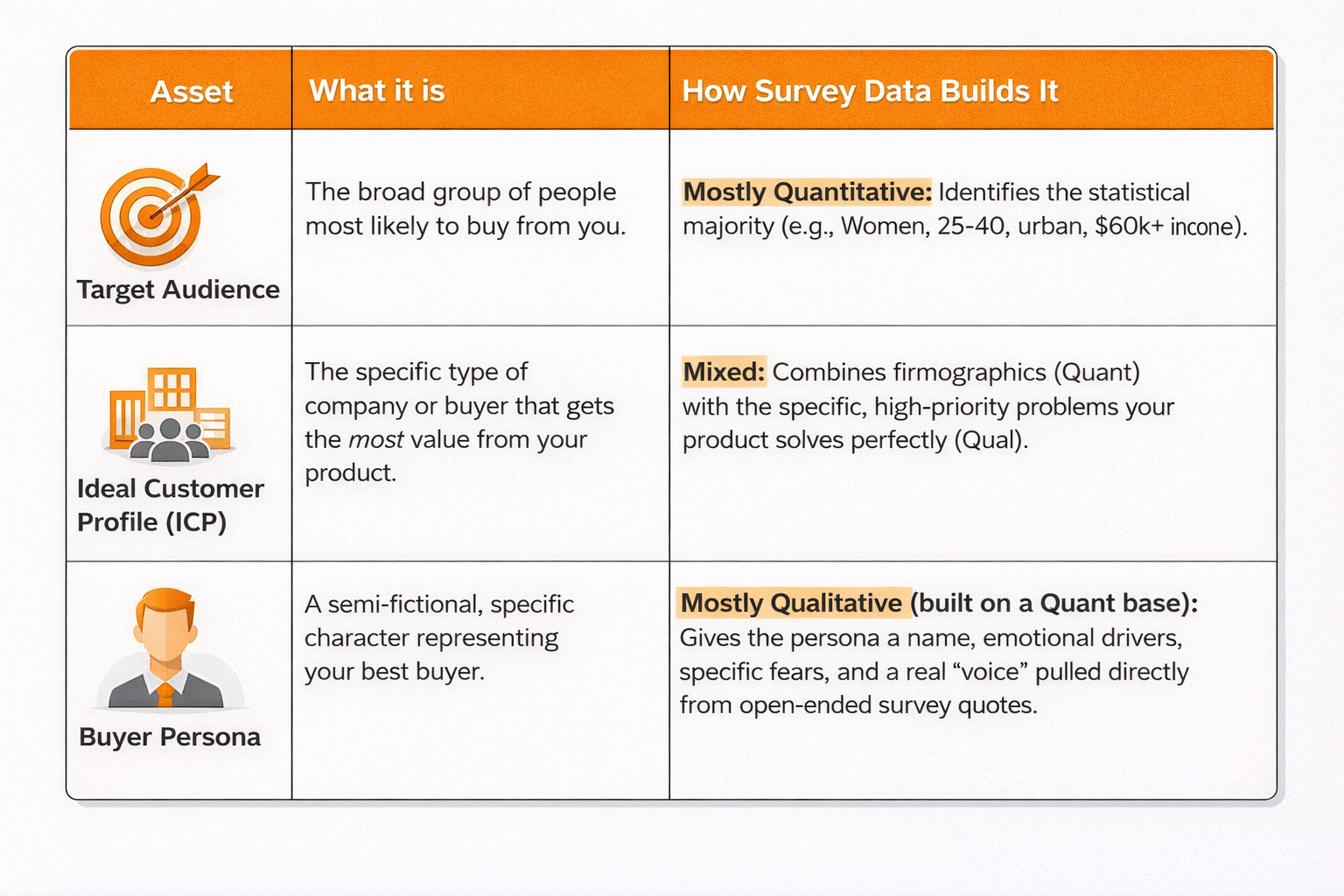
Your Target Audience is the broad group of people most likely to buy from you. This is the widest lens you use to look at your market.
- Data to use: To build this, your approach is mostly quantitative. It identifies the statistical majority.
- How to apply it: You look at the averages from your surveys. For example, your data might reveal that your audience consists primarily of women, aged 25 to 40, living in urban areas, with a $60k+ income. You use this profile to set the baseline targeting parameters for your advertising platforms.
2. Building Your Ideal Customer Profile (ICP)
Your Ideal Customer Profile (ICP) narrows the focus. It defines the specific type of company or buyer that gets the most value from your product. These are the people who are easiest to sell to, stay with you the longest, and refer others.
- Data to use: Building an ICP requires a mixed data approach.
- How to apply it: You combine firmographics (quant) with the specific, high-priority problems your product solves perfectly (qual). You use the numerical data to filter out companies that are too small or in the wrong industry. Then, you use the qualitative data to identify which of those remaining companies have the exact pain points your product fixes best.
3. Crafting Your Buyer Persona
The Buyer Persona is the most granular level of your research. It is a semi-fictional, specific character representing your best buyer. While the ICP looks at the account level, the persona looks at the individual human being who will sign the contract.
- Data to use: This asset is mostly qualitative, but it is built on a quantitative base.
- How to apply it: You start with the demographics from your Target Audience. Then, you use your interview data to give the persona a name, emotional drivers, specific fears, and a real "voice" pulled directly from open-ended survey quotes. This document helps your content writers and sales teams remember they are talking to a real person with specific daily challenges.
Conclusion
Effective market research requires a balance. You need the structured surveys and demographics to understand the size and shape of your market. You need the open-ended interviews and customer quotes to understand how to communicate value. By correctly applying both data types to your Target Audience, ICP, and Buyer Personas, you build a marketing strategy grounded in reality.


Discussion